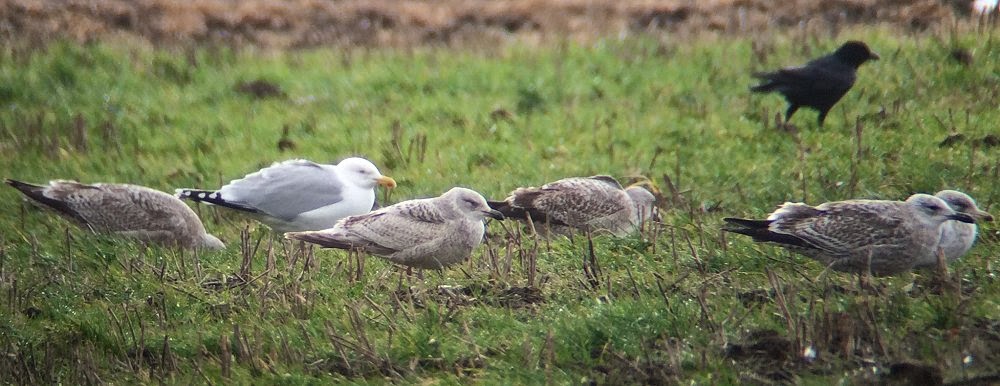
Well that was unexpected. Just back into a bit more regular gulling, but driving to work in East Yorkshire, and came across an early morning post-roost flock of c100 Herring Gulls. Onto the verge, quick scan, and a sleeping juvenile that instantly shouted Caspian Gull! The dingy colouration, long narrow scaps, long legs and wings, and cracking greater coverts were all spot on. When it woke, the pale head, narrow bill and indented eye added to the look - what a bird!
Tuesday, 28 July 2015
Albert Village Lake, 9th & 16th July 2015
It's the same every summer, I never mean to stop gulling, but work gets busier and takes me to laridly less-trodden places. Therefore a smart 2cy Caspian Gull at Roos, East Yorkshire, in the bright shimmer of a late April afternoon was a nice surprise, and the last decent gull for a few months.
And so to July, and the end of the main thrust of breeding bird surveys, and a chance to check in on a gull site or two. The 9th was a frustratingly sunny affair at Albert Village Lake, but c800 LBBs were present, and accompanied by not one but two 2cy Caspian Gulls. There were also a dozen michs, including at least 3 cracking juvs, that would have been my first of the year were it not for a wholly unexpected flyby at South Gare the day before!
A week later I was back, better light but alas fewer and flightier birds. The more distinctive of the two Casps was present throughout, and remarkably a 3cy made an all too brief visit. Again the michs provided much of the entertainment though, with probably 15 birds during the session, at least 5 of them juvs. But already there were a handful of juv LBBs and 2 juv Herrings present.
Saturday, 14 March 2015
Blyth, Teesside & Rufforth, 4th-6th March 2015
After Monday's excitement, the rest of my week away felt quite tame, but a selection of white-winged gulls kept the interest up.
First off was a bright juv Iceland Gull that joined the gulls gathering on the rocks off Blyth harbour on the morning of the 4th, just a shame the light was so bright.
Later that day I was down on Teesside, and whilst watching a smart GND off South Gare, a big buffy juv Glauc threw itself into a small feeding flock nearby.
The following day was spent on Teesside again, and the long-staying juv Glauc was amongst fewer gulls than of late at Seaton Carew.
On the 6th I had time for another look at Rufforth on the way south, but the sun came out as I arrived, and the heat haze made viewing a challenge. All was not lost though, and I left with a fine haul: the ad Kumlien's, ad Iceland, ad Glauc, new 2cy Caspian Gull and the big white leucistic GBB. Not bad!
First off was a bright juv Iceland Gull that joined the gulls gathering on the rocks off Blyth harbour on the morning of the 4th, just a shame the light was so bright.
Later that day I was down on Teesside, and whilst watching a smart GND off South Gare, a big buffy juv Glauc threw itself into a small feeding flock nearby.
The following day was spent on Teesside again, and the long-staying juv Glauc was amongst fewer gulls than of late at Seaton Carew.
On the 6th I had time for another look at Rufforth on the way south, but the sun came out as I arrived, and the heat haze made viewing a challenge. All was not lost though, and I left with a fine haul: the ad Kumlien's, ad Iceland, ad Glauc, new 2cy Caspian Gull and the big white leucistic GBB. Not bad!
Friday, 13 March 2015
Rufforth, 2nd March 2015
Well this wasn't a species I thought I'd be writing about again any time soon, and certainly not at another inland English location...
Monday 2nd March was a bitterly cold but sunny day with wintry showers rattling through on a brisk westerly at work near Goole, but by early afternoon I was finished and heading north. I'd promised myself a stop at Rufforth but on arrival there were no gulls in the fields on the bypass, and none along the B1224 either. Even the tip looked a bit quiet on first impressions, but as I pulled into the airfield, a few hundred large gulls were on the runway, so I settled down to watch them from the comfort of my car.One of the first birds I looked at was a first-winter Caspian Gull, followed by a big beefy 'northern' Argentatus with milky brown primaries. Another pale-winged bird caught my eye, having some of the jizz of an Iceland-type, but the coverts looked oddly bleached and the mantle contrastingly dark, and thoughts quickly turned to mixed genes. There were suggestions of Kumlien's there, but I never saw the spread wing as it suddenly disappeared, so who knows. A few birds further along was a second-winter Iceland Gull, presumably the bird that's been present for a few weeks, but good to see nonetheless.
With an impressive tally of gulls already on the daylist, I moved around to the other side of the airfield, where I bumped into local guller Chris Gomersall. Soon afterwards one of the light aircraft trundled out from the hangars, which we hoped might just shuffle things a little, but in fact it cleared the airfield of gulls! I settled on watching a few hundred birds in the adjacent sheepfield whilst Chris headed off, and after a while a distinctive head caught my eye. All the gulls were head-on, facing me and the wind, so it was difficult to see plumage details, but this striking bird, with a large-looking dark eye in a rounded head, and a fairly small, pinkish-based bill, made me stop in my tracks. The breast and belly were the colour of the stone-cold latte next to me, and undeniably smooth, American smooth in fact. I flirted with the outrageous suggestion of Thayer's Gull, but I'd been here before, and I'd not even seen its wings yet!
I stuck with it as it snoozed behind other birds, or drank from the puddle in the field, and gradually it revealed itself to me. The greater coverts formed a muddy bar with finely marked tips, whilst the lesser and median coverts were intricately marked and quite unlike the surrounding Herrings. The mantle and scaps were a bit messy, and details were hard to see, but the tertials were fractionally darker than the greater coverts, with broad, lacy white tips. The primaries were the darkest part of the closed wing, but they weren't black, and on occasion I could see creamy chevrons at the tips. Maybe my first instinct wasn't quite so outrageous, but how to prove it, my phone-scoped images were awful given the light and distance.
I knew that I needed to see it fly, but it looked pretty settled, and even if they did take off, they'd fly straight at me, not the best angle to view primary patterns... Sure enough, when something disturbed the flock, the bird lifted and I just snapped away, hoping for the best. They came down again and I flicked through the images on my phone. There was a suggestion of a silvery underwing and dark tips to the undersides of the outer primaries, but it'd be tricky to prove it wasn't photographic effect, and there was nothing of the tail.
Then the flock flew again, and this time poured over the trees and onto the airfield! I repositioned myself and scanned through the ranks of gulls, now closer and lined up side-on ready for inspection. Nothing. I scanned again, trying not to get too buffeted by the wind, and suddenly there it was, right on the front edge of the flock. I snapped away, and it flew a short distance to join a group of Herring Gulls, but that was all I needed. It was a Thayer's Gull, and a belter! The outer five primaries had dark outer webs flicking back around the tips like the clichéd Nike tick, whilst the inner primaries were paler with dark spots at the tips. The secondaries formed a smooth dark bar, as dark as the outer primaries, and the underwing was beautifully silvered. The tail was largely dark and smooth, and the rump and uppertail coverts were heavily barred.
I was straight on the phone to Stu at RBA to tell him that lightning can indeed strike twice, and the news was out. I tweeted a few images to comfort the doubters, and settled back to enjoy it. Minutes later however, a dog-walker appeared, and the flock flew, this time failing to resettle, and the few rapid-response twitchers failed to connect. It was reported by a single observer the next day, but not since.
Twice in one lifetime... bonkers!
Sunday, 1 March 2015
Albert Village Lake, 20th & 25th Feb, 2015
Longer days means more time to play on the way home from work, and a couple of visits to my new found playground were squeezed into the end of the month. Fewer gulls were present that in January, but the totals were still quite satisfactory.
On 20th there was an adult and a 2cy Casp on the bank across the road on arrival, and later I found a 3cy on the lake (which then showed up in a flight shot from the original bank! photo above). Later on that afternoon a big flush of the all the gulls on site resulted in a brief flight view of the recent 4cy Glauc too.
Five days later there were fewer gulls again, but the spotty-mantled 3cy Casp showed on the lake again, followed by the dirty-headed 2cy from back in January! A second 3cy was seen only briefly preening on the far bank before being flushed by a dog. Half a dozen michs were seen both days too.
On 20th there was an adult and a 2cy Casp on the bank across the road on arrival, and later I found a 3cy on the lake (which then showed up in a flight shot from the original bank! photo above). Later on that afternoon a big flush of the all the gulls on site resulted in a brief flight view of the recent 4cy Glauc too.
Five days later there were fewer gulls again, but the spotty-mantled 3cy Casp showed on the lake again, followed by the dirty-headed 2cy from back in January! A second 3cy was seen only briefly preening on the far bank before being flushed by a dog. Half a dozen michs were seen both days too.
Thursday, 26 February 2015
Seaton Carew, 13th & 19th Feb 2015
Two visits to Teesside in two weeks meant two visits to North Gare and the adjacent Seaton Meadows landfill, and on each lunchtime foray I was rewarded with two juv Glaucs. However there were three birds involved, as the dark, almost chocolate juv seen on 13th was not one of the two more typical birds seen on 19th.
Rufforth, 12th Feb 2015
Following a blank visit after work the previous week, I arrived early afternoon with a couple of hours free, and started with the large loafing flock by the bypass at Knapton. The first bird to catch the eye amongst the throng of Herrings was a dark-mantled 2cy with fairly plain scaps with simple anchors, and a whitish head with parallel dark bill - some cachinnans genes in there maybe?
A couple of northern argentatus types kept me entertained for a while, and then a striking adult-type gull walked through my scope, immediately ringing Casp bells. Mantle tone was good, the legs were long and colourless, the head small, white and rounded, and the eye looked dark on first impressions. The visible underside of P10 didn't immediately look great, and without a view of the spread wing it was never seen properly, but a narrow black bar across the long white tip, and a tongue peeping out on some views, were all within range. In addition, a broad black band could be seen across both webs of P5. On better views, the iris was seen to be dark yellow-amber, the orbital ring was red, and whilst the bill wasn't particularly long, it was narrow and lacking much of a gonys.
All in all, it looked ok for a Caspian Gull, but the most significant feature was perhaps the orange ring on its left leg: ZV5T. On reading the code, I had a sense of deja vu: orange rings aren't what you expect on a Casp, but that code sounded familiar... a quick Google search and it all came back to me - I'd seen this bird before, at Kirkby-on-Bain landfill site in Lincs in September 2012 as a 2cy! It had been ringed by the North Thames Gull Group at Pitsea in October 2011, as a Caspian Gull. A bit of correspondence with Paul Hawkins and more details emerged - following my sighting in 2012, it was seen a couple of times at Skegness in August 2013, then in November and December 2014 it was at Terschelling, Netherlands, being last recorded there on 30th Dec, only six weeks before appearing at Knapton!
A couple of northern argentatus types kept me entertained for a while, and then a striking adult-type gull walked through my scope, immediately ringing Casp bells. Mantle tone was good, the legs were long and colourless, the head small, white and rounded, and the eye looked dark on first impressions. The visible underside of P10 didn't immediately look great, and without a view of the spread wing it was never seen properly, but a narrow black bar across the long white tip, and a tongue peeping out on some views, were all within range. In addition, a broad black band could be seen across both webs of P5. On better views, the iris was seen to be dark yellow-amber, the orbital ring was red, and whilst the bill wasn't particularly long, it was narrow and lacking much of a gonys.
All in all, it looked ok for a Caspian Gull, but the most significant feature was perhaps the orange ring on its left leg: ZV5T. On reading the code, I had a sense of deja vu: orange rings aren't what you expect on a Casp, but that code sounded familiar... a quick Google search and it all came back to me - I'd seen this bird before, at Kirkby-on-Bain landfill site in Lincs in September 2012 as a 2cy! It had been ringed by the North Thames Gull Group at Pitsea in October 2011, as a Caspian Gull. A bit of correspondence with Paul Hawkins and more details emerged - following my sighting in 2012, it was seen a couple of times at Skegness in August 2013, then in November and December 2014 it was at Terschelling, Netherlands, being last recorded there on 30th Dec, only six weeks before appearing at Knapton!
A big flush of the field meant it was time to move to the airfield itself, and whilst masses of gulls milled around above the tip, another huge flock took off from the nearby field and began swirling about overhead. I chance scan upwards immediately produced the recent adult Kumlien's Gull, the neat grey markings on the outer webs of P8-10 visible, and some tiny indistinct grey markings in the outer primary tips too. Surprisingly there were also gulls in the field behind the airfield (it always amazes me how many gulls you get at Rufforth), and after a few minutes the Kumlien's dropped in, one of closest birds too! It's at the more subtle end of the spectrum, but the markings are there!
Endless scans through the thousands of gulls that were dropping in failed to produce much new, but eventually a big smart 2cy Caspian Gull appeared, and then it was time for me to go.
Yet again, given some time, the mighty Rufforth tip produced a fine selection of good gulls, but there are always more out there... this showed up half an hour after I left!
| 2cy smithsonianus by Tim Jones |
Subscribe to:
Posts (Atom)